In the refining, petrochemical and fuel production industries, the presence of sulfur in hydrocarbon compounds is one of the main challenges. Sulfur and its derivatives not only cause environmental pollution, but also cause equipment corrosion, fuel quality degradation and increased operating costs.
For this reason, the desulfurization process – sometimes known as sulfur removal – is recognized as one of the most important steps in modern fuel refining.
Relying on in-house technical knowledge, process chemical engineers and a specialized laboratory, Petrolino offers comprehensive desulfurization services for a wide range of petroleum compounds.
Why is desulfurization important?
The presence of sulfur compounds such as thiophene, dibenzothiophene (DBT) or mercaptans in fuel can cause destructive effects at an industrial and environmental level:
- Production of SO₂ and SO₃ during combustion → main source of acid rain
- Corrosion of metal equipment in transmission lines, tanks and boilers
- Reduced combustion efficiency and filter contamination
- Increased treatment costs and the need for frequent maintenance
For this reason, today refineries and oil companies are required to reduce sulfur to less than 10 ppm in light and heavy fuels.
What is desulfurization and how is it different from desulfurization?
In fact, both terms refer to the same goal — the removal of sulfur compounds from hydrocarbons — but they have some small technical differences:
In industry, these two terms are often synonymous and used interchangeably in technical documentation and contracts.
| Term | Translation | Scope of use | Main goal |
|---|---|---|---|
| Desulfurization | Physical or chemical removal of sulfur | Process engineering, refineries | Reducing sulfur concentration in fuel |
| Sulfur Removal | Direct separation of sulfur compounds | Applied Chemistry, Quality Control | Cleansing of DBT, H₂S and mercaptans |
Petrolino desulfurization technology
Petrolino is able to reduce sulfur to levels below 10 ppm by using Hybrid Desulfurization Technology, which includes physical adsorption, catalytic oxidation, and modified hydrotreating methods.
Petrolino technology features: Removal of DBT, TBT and mercaptans up to 99% Compatible with light and heavy hydrocarbon cuts No need for high pressure or temperature (Low-Energy Process) Use of Petrolino’s proprietary nanostructured catalyst Possibility of recycling sulfur from the process
Mechanism of action of the adsorption stage: Sulfur compounds are adsorbed by activated adsorbents based on modified carbon or metal oxide. Selective oxidation: Organic sulfur compounds (such as DBT) are converted to sulfones. Phase separation: The oxidized sulfur is separated from the hydrocarbon phase and can be recycled or purified.
Comparison with conventional methods
| Method | Process conditions | Cost | Efficiency | Limitation |
|---|---|---|---|---|
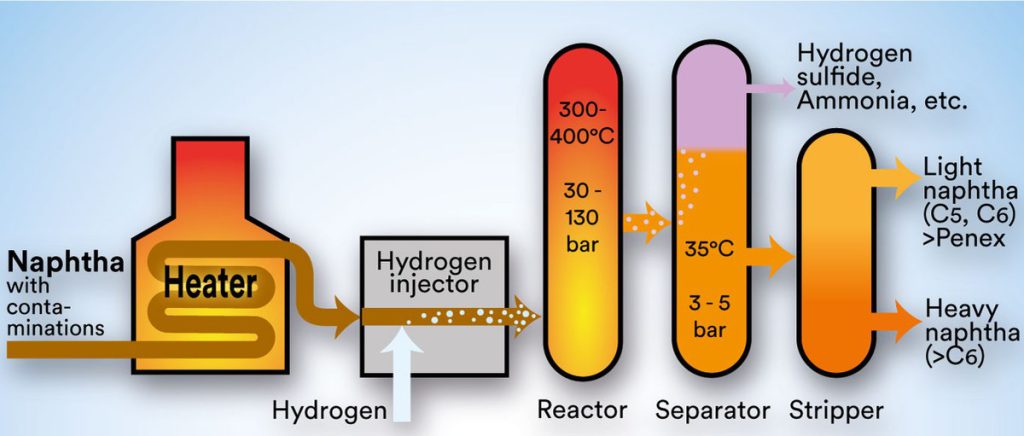
| Hydrodesulfurization (HDS) | High pressure, temperature 300–400°C | A lot | ۹۵٪ | High hydrogen consumption |
| Oxidative Desulfurization (ODS) | Atmospheric pressure, 50–80°C | Medium | ۹۹٪ | The need for a stable catalyst |
| Adsorptive Desulfurization (ADS) | Low temperature, no pressure | Down | ۸۵٪ | Rapid saturation of the absorbent |
| Hybrid (پترولینو) | Low pressure, 50–70°C | Medium | ۹۹٪ | Recyclable |
Petrolino's specialized desulfurization services
With more than 15 years of experience in the field of refining and purifying petroleum compounds, Petrolino is today one of the few Iranian companies that offers desulfurization services on a customized basis, on-site or in its process units.
The goal of these services is to reduce the sulfur percentage in light and heavy hydrocarbon cuts, improve the quality of fuels and lubricants, and increase the economic value of petrochemical products.
Petrolino Desulfurization Service Range
| Service Type | Description | Input Sulfur Concentration Range | Target Outlet Concentration |
|---|---|---|---|
| Diesel Desulfurization | Sulfur Reduction from 500 ppm to <10 ppm | 300–500 ppm | <10 ppm |
| Light Cuts Desulfurization (Naphtha, Gasoline Base) | Refining for Use in Petrochemical Processes | 50–300 ppm | <5 ppm |
| Desulfurization of heavy cuts (kerosene, heavy diesel) | Increase thermal stability and reduce corrosion | Up to 0.5% | <0.01% |
| Desulfurization of industrial solvents and oils | Removal of organic sulfur compounds (DBT, TBT) | Up to 1% | <50 ppm |
| Regeneration of desulfurization adsorbents and catalysts | Revitalization of existing systems in Refineries | — | — |
How to implement Petrolino services
Petrolino offers desulfurization services with two operating models:
1. On-Site Service (at the customer’s location): Installation and commissioning of a small temporary desulfurization unit at the tank or production unit, continuous monitoring by process engineers, output analysis and issuance of a quality certificate (Certificate of Sulfur Reduction). 2. In-House Processing (at Petrolino’s unit): Transfer of the cargo to Petrolino’s central processing unit, desulfurization operations in dedicated filtration reactors, and re-delivery with industrial packaging.
This model is suitable for companies that do not have access to purification equipment but want to bring their fuel or oil up to environmental standards.
Ingredients and technologies used
Petrolino uses a combination of modern and localized technologies in its desulfurization services, which can be customized to suit the type of cut and sulfur structure:
Selective Oxidation Technology (ODS) Using nano-oxide catalyst (V₂O₅–TiO₂) Oxidation of dibenzothiophene (DBT) to sulfones Reaction at 60–80°C without the need for high pressure Physical Adsorption Technology (ADS) Using modified activated carbon adsorbents or metal zeolites Removing H₂S and mercaptans from gas or fuel Hybrid Desulfurization Technology Combining the two above technologies Recycling of adsorbents and their regeneration up to 10 cycles Suitable for light refining units (Mini Refinery)
Benefits of Petrolino Desulfurization Services
| Advantages | Technical and economic explanation |
|---|---|
| High efficiency (up to 99%) | Achieving sulfur levels of less than 10 ppm without compromising fuel quality |
| Low-cost process | No need for high pressure or hydrogen |
| Safe and green | No emission of toxic and biodegradable gases |
| Can be implemented at the customer’s site | Suitable for small and medium-sized companies |
| Technical support Engineering | Pre and post-process fuel analysis by Petrolino Laboratory |
| Increase in refined fuel sales value | Achieve Euro 5 and export standards |
| Reduce equipment corrosion | Remove corrosive sulfur compounds from the process circuit |
Comparing Petrolino’s performance with competitors
| Index | Petrolino | Conventional methods (traditional HDS) |
|---|---|---|
| Process temperature | 60–80°C | 350–400°C |
| Working pressure | Atmospheric | 40–60 bar |
| Energy consumption | Very low | Very high |
| Cost Start-up | Low | High |
| Process time | Short (1–2 hours) | Long (6–10 hours) |
| Environmental safety | High | Requires ventilation and explosion-proof system |
| Sulfur recycling | Yes | No |
Applications of Petrolino desulfurization services in various industries
Oil and Refining Industries: Purification of light and heavy cuts to produce Euro 5 fuel Removing sulfur from naphtha before cracking in petrochemical units Increasing the quality and octane number of gasoline products Lubricant and oil industries: Removing sulfur compounds from base oil Preventing the formation of corrosive acids in lubricants Chemical and solvent industries: Purification of organic hydrocarbons for sensitive industrial uses (cleaning solvents, pharmaceuticals, paints and resins) Transportation and power plants sector: Removing sulfur from power plant diesel and diesel used by the transportation fleet Increasing the life of filters and afterburning systems (Catalyst Systems)
Petrolino's environmental approach
Petrolino always adheres to the principle of Green Chemistry in process design and chemical selection. As a result, the company’s desulfurization process:
It does not use toxic compounds such as chlorine and nitrites. Process waste is completely recyclable. Sulfur gas emissions during the process are close to zero.
These features enabled Petrolino to receive the HSE-MS Level A certificate from the National Center for Industrial Safety in 2014.
Technical specifications of Petrolino desulfurization services
| Parameter | Standard Range | Technical Description |
|---|---|---|
| Fuel Type/Cut | Naphtha, Light and Heavy Gasoline, Refinery Cuts | Petrolino Service Acceptable Range |
| Inlet Sulfur Concentration | 50 ppm to 0.5% | According to customer analysis |
| Outlet Sulfur Concentration | Less than 10 ppm (light fuel), less than 50 ppm (heavy cut) | Quality Assurance with LC-MS Analysis and XRF |
| Process temperature | 60–80°C | Low energy and safe |
| Process pressure | Atmospheric | Cost reduction and high safety |
| DBT removal efficiency | 95–99% | GC-MS and UV-VIS analysis |
| Process time | 1–2 hours | Depending on the type of cut and volume |
| Energy consumption | 30–40% less than HDS Traditional | Optimized by Petrolino engineers |
| Catalyst type | Vanadium-Titania nano oxide | Recyclable up to 10 cycles |
| Waste | Recyclable / Refined | EU REACH compliant |
This table helps industrial managers make purchasing and utilization decisions for desulfurization services with accurate data.
Safety and maintenance tips for desulfurization services
Work safety Use of personal protective equipment (PPE) including gloves, goggles and masks Avoid direct contact with catalysts and active chemicals Maintain a safe distance from hot equipment and process steam Environment and maintenance Perform services in units with proper ventilation Control temperature and pressure according to Petrolino instructions Store catalysts and active materials in closed and dry containers Collect and recycle waste according to HSE standards
Competitive advantages of Petrolino desulfurization services: Reduction of equipment corrosion risk: Removal of corrosive sulfur compounds. Reduction of energy costs and hydrogen consumption: Low-Energy Hybrid process. Possibility of performing on-site: No long downtime of production lines. Engineering and laboratory support: Precise control of sulfur concentration before and after the process. Compliance with environmental standards: Reduction of SOx emissions and waste recycling.
FAQ
What are the steps involved in the Petrolino desulfurization process?
It involves physical adsorption, selective oxidation, and phase separation. Each step is performed with precise control of temperature and flow.
Are Petrolino services applicable to all hydrocarbon cuttings?
Yes, it includes naphtha, light and heavy diesel, refinery cuts, and industrial solvents.
How long does it take for the sulfur concentration to decrease?
Usually between 1 and 2 hours depending on the volume and type of cut. Instant analysis report provided by the technical team.
Are Petrolino desulfurization services safe and environmentally friendly?
Yes. The processes are low-pressure, low-temperature, and without harmful gas emissions, and the waste is recycled.
How can I place an order for desulfurization services?
Lorem ipsum dolor sit amet, consectetur adipiscing elit. Ut elit tellus, luctus nec ullamcorper mattis, pulvinar dapibus leo.